How we spend our days is, of course, how we spend our lives. Annie Dillard
Is grad school a good idea?
Penelope Trunk trots out one of her regularly visited themes: why grad school is a bad idea. It rankled me a bit but I do have to remember that she’s talking to twenty-somethings and I’m a forty-odder.
Her advice would be right-on to my 23-year-old self: I had very little direction, a graduate degree would have been wasted on me, and my next 25 years or so would be spent working (or not), gathering experience. and developing as a person.
The comments to her post are as opinionated, so she succeeded in stirring up some thoughts and opinions (much of it taking her to task–rightly–for her crack about the military.) Though I kind of understand her point — if you don’t have a direction, then entering grad school or the military could lead down paths that may not be right for you — it was a carelessly thought out remark.
As many of the commenters note, a graduate degree can bump up your pay grade (that’s what my employer does) and, after years of job-hopping, it can be useful to get a degree that tells the world — your bosses, your peers — that you do in fact know what you’re doing.
My manager is getting an MBA through NCSU and it’s been a transformative experience for him: he’s made great local contacts, he’s extended his skillset, and he now has a degree that qualifies him for bigger and better-paying jobs. Had he simply read the books and gone to local networking meet-ups, he would never have received the validation that he gets when he meets with his managers and with local executives in meetings set up by his school.
For myself, I have enjoyed my master’s experience tremendously. One of the most important things I learned was that I can apply my odd agglomeration of skills and abilities to more than the narrow band of activities I’ve grown accustomed to. The other important thing was that it awoke my intellectual side, which the last 25 years of work has rather successfully smothered (except when it was useful to the project, of course). And I’ve found my professors to be up to date on what’s happening in the big ol’ world outside of Manning and to be very generous with introductions to people they know in academe and industry, thus extending my personal network.
Still, her article is one of those goads that my reticular activating system has been sending my way as I contemplate the PhD. Does it make sense to leave a guaranteed paycheck to go to school full-time in this economy? Will I be able to find work as a 50-something PhD when I graduate? What, really, do I want to do with my life and will grad school help me get there?
That’s the real question I think Penelope means for her readers to ask themselves.
![Reblog this post [with Zemanta]](https://i0.wp.com/img.zemanta.com/reblog_e.png)
Financiers tell their not-for-attribution account of the mortgage crisis like this: Americans undersaved and overspent for decades, relying on rising property values to bankroll their lifestyles. But nobody on Wall Street forced United States homeowners to take out loans on houses they couldn’t afford, or refinance mortgages to spend money on cars they shouldn’t have bought.
Research Journal for my 780 class

- Cover of 7 Up
Since our 780 Research Methods class doesn’t have a Blackboard site for the class, I’ll post my various links and thoughts to the blog, tagged with “780.”
I wonder if Michael Apted’s wonderful Up series of documentary interviews would be an example of a kinda sorta longitudinal study or panel study? When a new film comes out every 7 years with updates on these people, it’s always fascinating to see where life has — or hasn’t — taken them. Instead of gathering statistics about a large group of people, there’s something very satisfying about getting to know a small group of people very well.
We’ve been talking about experiments, planning a study, theories, types of studies, etc. One of our last readings was about where one gets ideas for theories. This reminded me of Seth Roberts, a Berkeley researcher in psychology, who frequently touts self-experimentation as a way to generate research ideas. This is one of his more famous papers. He maintains an active and entertaining blog.
What I admire about Seth Roberts is his abundant idea-generation and his zeal for measurement and record-keeping. His goal is to experiment on himself first, then if his data indicates that there are possibly interesting results, then he proceeds with more methodical testing and inquiry, possibly leading to more formalized studies (or not).
When I’ve been thinking about possible studies I might like to try, I remember this quote from one of his blog posts:
SR: Tell me something you’ve learned about research design.
BW: When I was a graduate student [at the Stanford Business School], I would jog on the school track. One day on the track I met a professor who had recently gotten tenure. He had only published three articles (maybe he had 700 in the pipeline), so his getting tenure surprised me. I asked him: What’s the secret? What was so great about those three papers? His answer was two words: “Cool data.” Ever since then I’ve tried to collect cool data. Not attitude surveys, which are really common in my area. Cool data is not always the easiest data to collect but it is data that gets buzz, that people talk about.
Thinking about what “cool data” might mean in a digital curation or archival or info-science context can be tough. I think the social networks are certainly perceived as cool and you can do cool stuff with them, certainly, but I’m not that curious about them. I feel like, were I to study one of them, I’d just be chasing a parade that’s got a five-mile headstart. Better to find my own parade. 🙂
Curiosity is probably what drives me. Certainly, one of the itches that a researcher must scratch is his or her own personal obsession with some nagging question or detail that no one has really addressed or answered to their satisfaction. (The same way most writers have to write their own poems, stories, and plays, because no one else is publishing what they want to read.)
Check out his numerous posts tagged scientific method (though he’s more usually critical of scientists’ behavior than the method itself) and self-experimentation for more.
Another great Seth Roberts post that got my attention was this one on appreciative thinking, especially as it relates to reading journal articles. I see what he describes in the classes I attend, where we read a paper that’s 1 year, 5 years, or 10 years old, and it’s rather thoroughly shredded during the ensuing discussion for any number of reasons (and I’ve been guilty of trashing articles, myself).
Instead of this negative critical thinking, I like his suggested questions to ask instead, especially the simplicity of his fifth question: “What’s interesting or enjoyable about it?” Even if I find the writing of an article stilted or atrocious, I think it should be possible to at least admire a piece’s energy, its intent, its point of view, its ability to stir thoughts in me, etc. Saying something constructive is not about becoming a positive-thinking ninny; it’s about seeing more sides of the issue than only one.
Even for a piece (Mabry’s “Reference Interview as Partnership”) that didn’t really touch me, I appreciated that this was the author’s distillation of a career’s worth of lessons that she wanted to impart. In my summary of the piece, I said I could see it being used to start a conversation about one’s own personal manifesto for serving at a reference desk. We’re not often asked to reflect on our larger purpose or philosophy when it comes to our jobs, or even our career, so I saw the Mabry piece as a terrific starting point for such a conversation.
Speaking of writing up experiments so they’re repeatable — how often does repeating an earlier experiment really happen?
Those whom history has judged as great often came from less and strived for more than wealth. High compensation doesn’t attract the very best. It attracts the greediest.
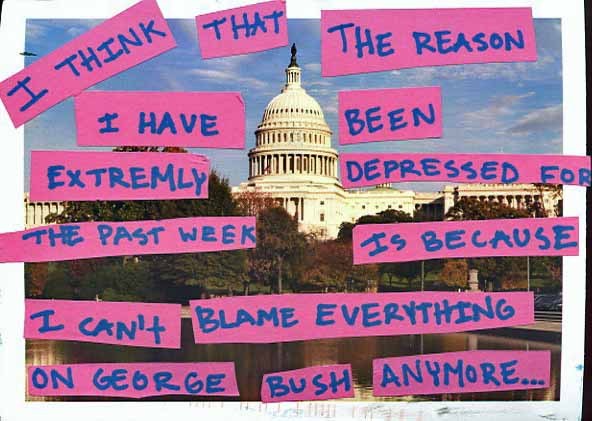
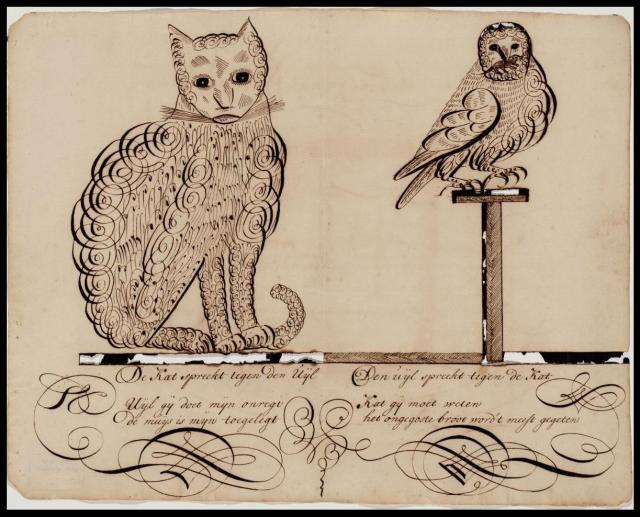
But forced idleness is a good thing, especially for a workaholic like I, and while I feel as if the knowledge I used to use at work, such as my ability to distinguish Jenson and Caslon (or Sunday and Monday), or the keystroke commands for Flash MX, are seriously diminished, it’s been replaced by the weird farrago of art-making skills, writing skills, arcane interests (nuclear explosions, gnosticism, mycology) and stuff I read, not entirely a bad thing, but I’ve all but ceased to be professionally useful, and as someone said recently, happiness consists of knowing that one is safe, loved and useful.
Annoying Firefox problem fixed
For the last couple of months, I’ve had an incredibly annoying problem in Firefox, when entering text into text boxes: the cursor would disappear, the text box would appear to lock up, and I’d have to click inside the text box to resume typing. Often, too, I’d hit the Backspace key and this would jump me back to a previous page, causing me to lose what I’d been writing.
I did several searches on this problem and finally located the answer here. I had set several bookmarks in my beloved Speed Dial extension to automatically update every hour or every four hours, etc. For my Gmail, I had it ping my inbox every few minutes. It was these dial-outs that robbed the focus from the text boxes: as I typed, Speed Dial was checking a web site and updating the thumbanil, and Firefox — unable to serve two masters — left me bereft.
Not wanting to disable Speed Dial, I instead set the bookmark updates to Never, and this seems to be working.
And yet even though this Christian nonviolence is in many ways the most mainstream aspect of this radical figure who’s become a mainstream icon, it’s something that none dare take seriously today.
 Brownstudy's Blog