Early in my writing career, I had an assignment to follow around a mohel–the guy who does ritual circumcisions in the Jewish tradition. My subject learned the trade by watching his dad, a renowned figure in the field. One day, father told son he was ready to handle the tools himself. Why now, the son wanted to know. “Most students ask me how much to take off,” the senior explained. “You asked me how much to leave on.”
Round Playing Cards of Master PW

Queen of Columbines

Five of Columbines

Ten of Columbines

Valet of Parrots

Nine of Parrots

King of Parrots

King of Hares

Knave of Hares

Valet of Hares

King of Roses

Queen of Roses

Ace of Roses

Three of Carnations

Valet of Carnations

Ace of Carnations
Martin Luther King – American Irony

In a nation that is preoccupied with God-talk, in which the separation of church and state is being eroded and denied, a nation in which our “conservative” politicians constantly invoke the Judaeo-Christian tradition, you’d think that a holiday in honor of a preacher-activist-humanitarian would merit a national holiday, i.e., a holiday that is universally observed the way Presidents’ Day is. Even a secular humanist atheist like me would support it.


Rambo Inflation
Number of people killed per minute in the Rambo series.
- Rambo: First Blood (1982): 0.01
- Rambo: First Blood Part II (1985): 0.72
- Rambo III (1988): 1.30
- Rambo IV (2008): 2.59
Hat tip to Peter Gordon.
“No Links Please” drains HREFs, discourages web fiddling
James Clarke – No Links Please!
Here’s a fun one. Our old pal (and the coiner of “life hacks”), Danny O’Brien, passes along an extreme attention aid that might be regarded as the heir apparent to his wonderful “Webolodeon” script for GreaseMonkey.
No Links Please will do its part to keep you from mindlessly surfing the web:
No Links Please! breaks the web by removing hyperlinks from all pages apart from Google. Without the knowledge or temptation of links you are free to devote…
Emails as a Game of Life?
Academic Productivity has another great post, this time on the work of Carolin Horn at the Dynamic Media Institute at the Massachusetts College of Art (a visual designer, BTW, not an information visualization specialist) and her coder Florian Jenett.
Using her Apple inbox as her petrie dish, her web page contains wonderful animations of species of hairy microbes that reflect the state of her inbox; spam and email from friends look totally different, while newer, more urgent mail is hairier and quicker. She also describes a grouping function of her project, titled Anymails, and the chains of microbes begin to look like early wormy life forms.
It puts me in mind of John Conway’s Game of Life, an artificial life simulation that obeys only a small set of rules yet can exhibit surprisingly varied behaviors. It would be strange to not see rows of text but instead colorful wriggling lifeforms in my inbox. You could make it a game to clear the inbox, or take a cue from the Game of Life, and have a squirming microbe spawn an instant reply.
Carolin has a fascination with the natural world and its possibilities over static user interfaces: one of her other projects is an encyclopedia of the arts represented by different classes of jellyfish.
Consumer Industrobotics


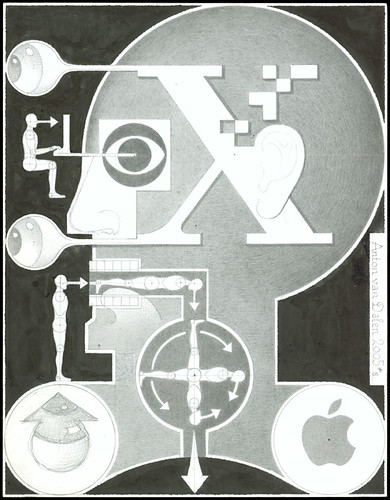


- All drawings 1965-2077 © Anton van Dalen.
- Anton van Dalen was the secret assistant to Saul Steinberg (The New Yorker magazine illustrator: i, ii, iii).
- Thanks Mooooooooon!
- Previously.
Real Screen Comics #117
![[Real Screen Comics #117]](https://i0.wp.com/www.coverbrowser.com/image/real-screen-comics/117-1.jpg)
Building models (info or economic) in your spare time
I enjoyed reading Hal Varian’s paper How to Build an Economic Model in Your Spare Time. It succinctly describes how to build a theoretical model for how a system may work, from getting the idea, to testing it out, to improving it. It requires you to have a little ambition and a little less ego. At the end, he summarizes his major points, and it strikes me that this is also a good way for any student or academician in any discipline to grow intellectually and think bigger thoughts.
- Look for ideas in the world, not in journals.
- First make your model as simple as possible, then generalize it.
- Look at the literature later, not sooner.
- Model your paper after your seminar. (Varian recommends leading a seminar on your model, which forces you to get your ideas in shape so your presentation both educates and entertains your audience.)
- Stop when you’ve made your point.
Of course, he goes into greater detail on these and other points, but I really liked the first one: read magazines to get an idea of the ideas and problems that are in the air. That appeals to my pragmatic side.
And since I’m a total software geek, I also enjoyed reading how he uses his computer to write his papers. At the time of the writing (the last update was in 1997) he used UNIX, kept a notes.txt file to contain ideas, thoughts, an outline, and in general used this file similarly to Mark Forster’s idea of continuous revision. Only after he’s collected ideas for weeks and months does he move to writing a first draft of the paper or chapter. He also uses UNIX’s rcs for a revision control system.
Insofar as his idea of writing notes from audience or seminar Q&As, I’d suggest you use either a tape recorder or get a volunteer to write the questions and comments down for you.
![[Superboy #21]](https://i0.wp.com/www.coverbrowser.com/image/superboy/21-1.jpg)
 Brownstudy's Blog