 FreeRice is a novel humanitarian project: for every correct definition one chooses, a participating company donates ten grains of rice to the United Nations World Food Program.
(Thanks, Ben!)
“This is a DIY I did on how to make a one sheet zine. D-I-Y — a real American Hero! Remember kids, Folding is half the battle. You’ll need: One piece of paper, scissors and a Pen…” (And here’s a step-by-step on Flickr: Wanna make a neat, fun zine that only uses one sheet of paper? Of course you do.)
“If you can pronounce correctly every word in this poem, you will be speaking English better than 90% of the native English speakers in the world. After trying the verses, a Frenchman said he’d prefer six months of hard labour to reading six lines aloud. Try them yourself.”

I always used a spoon until I was given one of these lid poppers. I was skeptical, but I now find myself reaching for it without even thinking. It’s an 8.5 by 5 cm piece of metal, bent in the middle and curved at each end to accommodate just about any size jar lid. It’s very simple and straightforward. You simply place it on the top of the jar with either of the rolled sides caught just under the edge of the lid (which side of the opener depends on the lid size). Your fingers hold the piece in place, which acs as a lever, and the bend in the metal serves as the fulcrum. The downward pressure of the heel of your hand provides just enough force to release the vacuum without distorting the lid. I can happily report no more bent spoon handles, no more splatters, no more spills, just a nice “pop” sound when the vacuum has been broken; then I know I am home free. I have not tried the plastic JarPop, but I’ve had this steel one for at least 3 years and it has never bent in anyway, nor has it rusted.
– Ellen Rocco

Lee Valley Jar Opener
$8
Available from Lee Valley
Related items previously reviewed in Cool Tools:
Yup, can’t stop…
(sailorblur): I don’t give a f***, I don’t give a f***, I don’t give a f*******************!
(pieman): I opened my back door to have a cigarette and there was a huge f*** off spider web across the outside. I screamed like a girl.
(rozic): could the ads on facebook s*** any worse? microsoft ad sales people need to wake up and go sell some real advertising
(mmpantsless): Does Qwest just intentionally f*** with their customers? Traceroute from 30 miles north of Minneapolis to dowtown St. Paul – goes through Chicago.
(cyounce): Oh. Dear. God. Bacon flavored chocolate doesn’t s***. Actually it is pretty good.
(chrisrbailey): Damn I should have asked for a quiet room, my neighbors s*** so far. The woman next door just said, “freedom is taking your bra off”.
(sjor): It can never be one thing. It has to be a whole slew of things together. F*** you, brain chemicals!
(jacksonwest): F*** Wheaties, the breakfast of champions is a slice of apple pie with cheddar cheese and a cup of coffee. That’s what I call nutrition!
(ramsey): I don’t think you’re happy enough. That’s right! I’ll teach you to be happy. I’ll teach your grandmother to s*** eggs.
(riddle): Watching a situation in supermarket. You know you s*** at parenting when your 10 year old child tries to beat you, crying.
And then there are the ones where you are just irrationally happy for the person without knowing anything else:
(moderndaymuse): Receiving a message from my stalker. Apparently he’s fed up with me and moving on. Ha ha ha ha ha Operation F*** Off – A success!
(anorexia): got the medication. thank f***.
And then there are the interesting implications of technology:
(piecesofvenus): I predict that the Razr’s prudish predictive text feature, which creates difficulty typing “f***”, will spur a linguistic change in “duck”.
(indieosaurous): P**** comes up before puppy in my predictive text.
And then there are the cautionary notes:
(polymerjones): Do not f*** with someone who straight punches a pterodactyl.
(panasonicyouth): Holy f***! Chevy Chase!
And then there are the piercing truths of the universe:
(fujikosan): people who perpetually emit unwanted sound s*** energy out of people who are quietly working
(bmf): Ever notice that “no offense” is just another way of say “f*** you”?
“Wilhelm!”
“Yeah, I’ll just fill my pipe.” [Over-the-top scream follows.]
One scream on screen, from 1953 to 1999. The compilation is hilariously good.
Wilhelm: The Man and His Scream, compiled by Pablo Hidalgo (YouTube)
Does That Scream Sound Familiar? (ABC News)
(Thanks, Ben!)


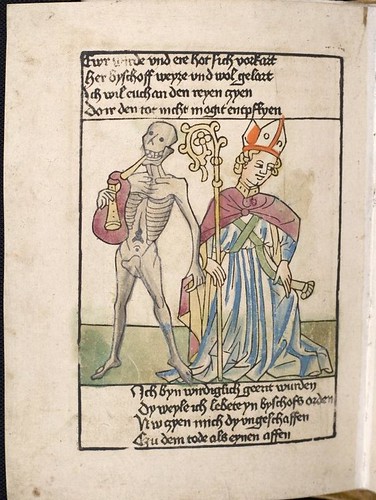


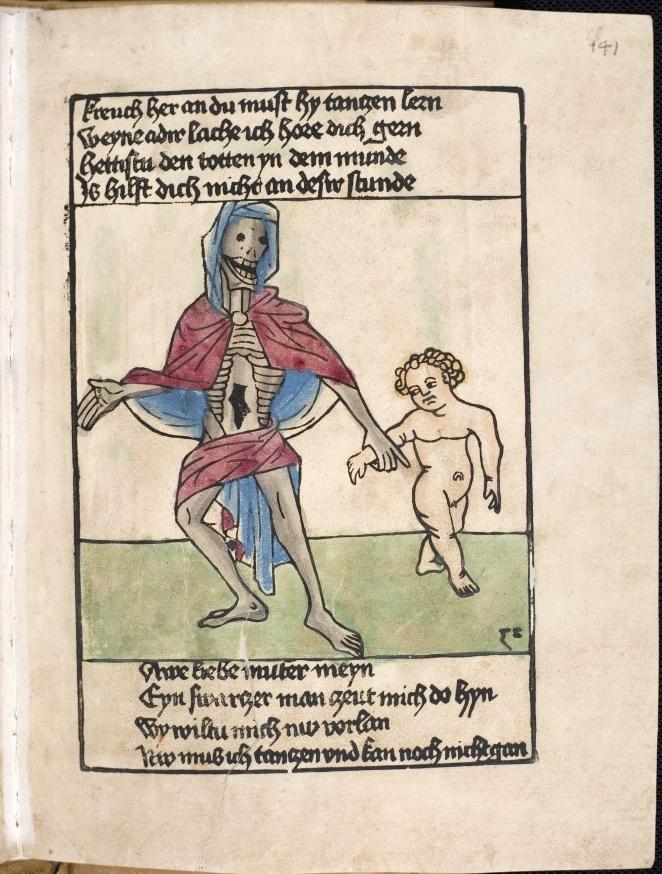
In 15th century Europe, a blockbook was a codex (‘gathered volume’) in which the text and illustration was printed onto a page from a single block of wood. The wood was engraved (xylography) and gouged out leaving the text and images as raised reliefs which were then inked and placed onto a double sheet of wetted paper.
Before the use of presses, the ink transfer was achieved by rubbing the verso of the paper with a round burnishing tool. The paper was printed on one side only because the rubbing would have ruined the original inked surface on the initial sheet. The pages of the blockbook were folded and assembled, with two printed pages followed by two blanks. The blanks were then glued together giving a continuous book as we know it.
In an age where both literacy and the quest for knowledge was on the increase, the blockbook system appears from this distance to have been a great advance over the earlier painstaking manuscript copying in scriptoriums. The process was cheap (but paper was expensive) and allowed for a form of mass production once the wood blocks had been engraved. As for downsides, carving both text and illustrations in a backwards form (so that when inked and rubbed they would be reversed and appear legibly) was technically demanding and more importantly, the blocks were only useful for one double-page from one book of course.
This relief printing technique had been first seen in Europe in Holland, probably as early as 1420, in playing cards and devotional religious images which had brief captions below the illustrations. The history of development from cards to books is hazy at best due to a dearth of surviving original material, but the blockbook format had its heyday between about 1450 and 1475. The works most closely associated with the technique were the Poor Man’s Bible (‘Biblia Pauperum’), the biblical Apocalypse story, ‘Ars Moriendi’ (the Art of Dying) and ‘Speculum Humanae Salvationis’ (the Mirror of Human Salvation).
But Gutenberg’s moveable type printing appeared in 1455 and, like betmax video or the netscape navigator browser of modern times, blockbook printing was eventually made redundant by the appearance of a better technology.
The images above are the oldest known book illustrations of the danse macabre/totentanz/dance of death genre, which had begun in France earlier in the 15th century as a visual response to the effects of the plague. The blockbook of twenty six illustrations was produced between 1455 and 1458 in Germany and depicts the traditional hierarchy of victims – such as Pope, monarchy, clergy, knight, farmer, infirmed, mother and child – visited by death and accompanied by a moralising snatch of verse on the inevitability of the subject’s mortality. The illustrations are hand coloured.
When Mike Reiss came to speak at the University of Chicago, he mentioned his favorite line never to make it on the Simpsons. When Homer faked his death in the Mother Simpson episode, Lenny originally said “He had the grace of Gene Kelly, and the genes of Grace Kelly.”
“The other day I got an e-mail from Carson Van Osten, a famous Disney artist who did many Disney Comic Books and created the famous “Comic Strip Artist’s Kit”. It was created to help beginning comic artists deal with perspective problems and other drawing difficulties. I scanned my old xeroxes a while ago. It’s probably the best thing I’ve ever seen about practical staging and drawing for storyboards or comic books.
Anyway Carson saw it on my blog and read what nice things people had said about it and it really meant a lot to him. And he offered to send me an original copy of the handout, which is 11 x 17. I’ll scan it big so you can really see it well and print it out on 11 x 17 paper if you want to. He was even nice enough to inscribe it to me and if you print it out big you can read it.
Here’s the history of the handout, in Carson’s own words…”


![[Sandman Mystery Theatre #70]](https://i0.wp.com/www.coverbrowser.com/image/sandman-mystery-theatre/70-1.jpg)
 Brownstudy's Blog