iPad Pro Observations

I subscribe to Daniel Lemire’s blog. He is a computer science professor at the University of Quebec. While his posts on optimal sorting and benchmarking bounce harmlessly off of me, I appreciate his take on academe, research, and the state of science and technology. His weekly links of what he considers notable science and technology stories in the news or research journals consistently interests me; here’s a recent edition.

He had a few observations on his attempt to use an iPad Pro for his daily work. His point about focusing on only one application at a time is a good one; it’s not as limited as the old days of using DOS software, but when I’m writing on the iPad, task-switching is a little cumbersome. And I agree that working with text is awkward; I use a clipboard utility that helps a little, but I really prefer a mouse over tapping to select or move text.

I don’t use my 10.5 iPad Pro daily; I use it mostly for web surfing or reading; I can’t say I’ve noticed my reading comprehension or activity to have changed. Perhaps I’m not using it enough. I am one of those readers who remembers the quote is on the bottom of the right page (spatial/geographic memory), an ability frustrated by any e-reader.

I did like his last observation, though:

My final point is that working with an iPad is more fun than working with a laptop. I cannot tell exact why that is. I’d be really interested in exploring this “fun” angle further. Maybe it is simply because it is different, but it is maybe not so simple. My smartphone is “fun” even if it is old and familiar.

I think one reason it might be fun is that we still haven’t quite unlocked how to work with it effectively. Once it becomes as boringly dependable as a laptop, it will likely lose some of its allure. The fact that it’s still a little difficult to use, that we still have to think about it a little, gives it a little more challenge that makes the experience a little more fun.

Jeanette Winterson on broken hearts and time

Jeanette Winterson:

My heart was broken recently and I keep the pieces on the back step in a bucket. A heart can mend but unlike the liver it cannot regenerate. A heart mends but the break line is always visible. Humans are not axolotels; axolotels grow new limbs. A broken heart will mend in time, but one of the contradictions of being human is that we have so little time for the mending we must do. It takes years to know anything, years to achieve anything, years to learn how to love, years to learn how to let love go when it has worn out, years to find that loneliness is the name for the intense secret you can’t share. Years to share what you can share. Years to be hurt. Years to heal.

Do I Need to Digitize This Album? Or Can I Download it Instead?

I could take the time to record both sides of an album, edit those recordings, create metadata, find the album art, and maybe create a digital booklet to go with it.

But Is there an easier way?

  • Check Amazon for CD or streamable version. If the album is streamable or available as a CD, then I won’t bother recording it. A digital copy will cost some money, yes, but the sound will be good, and the album art and metadata will be in place. Does the record mean so much to me I want to buy the CD? That will be One More Thing to add to my load, when the goal is actually to lighten my load.

  • Check iTunes. Some vendors sell their wares in one place but not the other, so it pays to check both.

  • Check YouTube or Vimeo. I use Replay Media Catcher to capture the audio; there are numerous similar utilities out there.

  • Check archive.org’s Audio collections. This is the court of last resort, but obscure treasures do show up here.

Is This an Album Worth Keeping?

After I finish digitizing a record and putting it in the Donate box, I pluck the next one from the shelf. And then a series of questions present themselves.

  • Am I interested in keeping a digital copy of this record? If I’ve forgotten I had it, if I haven’t thought about it in decades, then maybe I don’t need to keep it. Into the Donate box it goes.

  • Do I want to give it a listen before I Donate it? If so, I may as well record it so I’m not risking damage to the record by playing it twice. On a few occasions, after listening to a few tracks, I know I don’t want to keep it. Into the Donate box it goes.

  • And the question of the moment: would it bring me joy to keep a copy of this album? I am currently stuck in a loop of recording some albums simply because no CD or other form of it exists elsewhere and the collector/hoarder in me is greedy to keep a copy “just in case.” (This one, for example.) Honestly, if that mythical case was going to happen, it would have already happened. Let it go.

If by the end of these questions I decide that I do want a digital copy of the record, I have another little checklist I go through. More tomorrow.

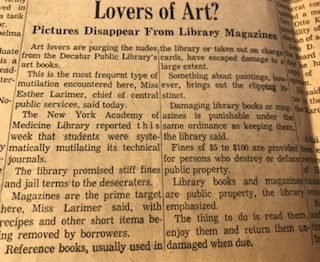
Lovers of Art?

From The Decatur Review, February 24, 1961:

Art lovers are purging the nudes from the Decatur Public Library’s art books.

This is the most frequent type of mutilation encountered here, Miss Esther Larimer, chief of center public services, said today…

Magazines are the prime target here, Miss Larimer said, with recipes and other short items being removed by borrowers.

Reference books, usually used in the library or taken out on charge cards, have escaped damage to a large extent.

Something about paintings, however, bring out the clipping instinct…

The thing to do is read them, enjoy them and return them undamaged when due.

As we sift memorabilia from the attic, we find clippings of graduations or job changes and promotions. But it’s often the other side of the clipping that is more interesting. (Austin Kleon has referred to this experience, how the little-valued of yesteryear becomes the most-interesting of today.)

  The Decatur Review , February 24, 1961
The Decatur Review , February 24, 1961

Fasting February

Search this blog for “diet” and you’ll find many posts on various strategies I’ve tried.

After many decades of staying in the 210+ range, I got down to the 205 +/- 5 lbs range and stayed there for a couple of years. But I wanted to do better.

Last year, after many years of off-and-on fasting regimens, I tried the One Meal A Day (OMAD) eating plan. I found it to be pretty easy and I got down to 194 lbs., the lowest I’ve been as an adult in living memory. (Although I think a weekend spent helping a friend move in late-July heat probably sped that loss.)

But I relaxed the diet’s constraints over the holidays; being at home during the government shutdown was restful, but it did not stop me from snacking. It’s time for a reset.

A few years ago, Liz and I tried a No-Sugar February; I think I lost 6 pounds. We found February to be a good time to try an extended challenge: it’s a short month, so anything seems possible. Also, it’s a respite between the Festivus excesses and the coming of Spring. February is a good month to hunker down and refocus.

Of course, trying to lose weight when it’s cold outside is a challenge. The body resists losing weight anyway and more so during the cold, dark days of winter.

Nonetheless, I’ve decided to go back to strict OMAD for February. When I implemented OMAD last year, I ate one meal a day roughly Sunday-Thursday, and relaxed the rules on Friday and Saturday. This time, I will eat only one meal a day from the first day of February through the last.

Per Joe’s rules for prep: my chosen weight range is 185-200, my 4-hour eating window is from 6-10pm, with my preferred hour for eating 6-7pm. My weekly weigh-in will be Friday morning.

I know there will be some days this month when I have lunch with a friend or Liz and I may have an early supper — that’s OK. That will still be my only meal and I go back on schedule the next day.

But one OMAD rule I cannot follow at this time: I gotta have cream in my coffee!

If I fall off the wagon (a snack, an extra meal), then I get back on as soon as I can. I appreciate the moment as an opportunity to experience and express gentleness toward myself, and carry on.

Joe’s OMAD site and forum have lots of information, and his YouTube channel hosts an impressive number of homemade videos filled with tips on practice and — what seems most important to him — mindset. I think Joe considers weight a thinking problem as much as a physical problem. Facing down one’s cravings is an opportunity to wrestle with your ego and your relationship to food. I think that, for Joe, the winner — or loser — is your character.

Myself, I want Fasting February to be as non-dramatic, non-struggling, and conflict-free as possible. If I fumble now and then, it’s because I’m human or I’m not working the system right. I have generally had trouble-free days when doing OMAD, and I’m confident most of February will go that way.

My weight this morning was 204.2. Check in on March 1 to see how I did.
Art is What Gets Away With You

Jeanette Winterson, one of my favorite writers on the meaning, experience, and vitalness of art:

Art isn’t what you can get away with … The work tells a different story. Art is what gets away with you. Every encounter with a work of art is an elopement. The seduction of the self, the abandonment of the self to a different kind of experience, is what art offers. Every renewal of the artistic method and process is an attempt to wrestle art out of the marriage and into the love-affair. By which I mean the Keep Out signs of convention, respectability, familiarity, jargon. The high priest cult of ‘art’ is a lie about what art is. Art is feeling and experience and excitement before it hardens into meaning.

The Tomb and the Telephone Box

From The Public Domain Review:

 From Wikimedia Commons. Photo by Christoph Braun.
From Wikimedia Commons. Photo by Christoph Braun.

Though Nikolaus Pevsner wrote that the nineteenth century “forgot about Soane”, it was ironically through his funereal-architecture that his spirit was revived. The ruined classical architecture of death had become one of the utilitarian icons of the twentieth century. These boxes are now relics on the streets, preserved by English Heritage and frequented by the occasional tourist … Like their architectural inspiration, these boxes now act as a memorial to a form of life now passed.