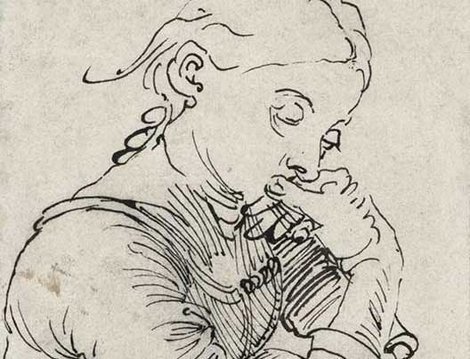
(via Dürer’s Devil Within by Andrew Butterfield | NYRblog | The New York Review of Books)
“It is the greatest of all mistakes to do nothing because you can only do little. Do what you can.” ~ Sydney Smith
Occasionally, just writing without a plan is a worthwhile exercise, especially early in the conception so you can hear the voices of your characters. But I’d leave writing any actual script of an episode until you know how it ends. You’ll think of a better ending as you write the script. But if you don’t have any ending when you start writing, you almost certainly won’t think of one.
Up early and walked down to Patti’s house, where we carpooled to the Creative Entrepreneur Expo 2013, sponsored by the Durham Arts Council. When I first saw the email advertising this half-day workshop, I thought, “No. I’m not a ‘creative,’ and I am not selling any services to creatives. So there.” But then Patti forwarded it to the neighborhood listserv. And then Liz reforwarded it to me. At this point, the knocking on my door is getting so loud I can’t ignore it any more. So I arranged with Patti that we would buddy-up and attend together. My intention was to have no goals or objectives about the day; I just wanted to expose myself to what was going on and see if anything resonated with me. Continue reading “Pretty much a perfick day”
And this is basically the viewpoint underlying Miles’s criticism: it doesn’t matter what Gatiss meant because the episode itself is horrifically xenophobic. But let’s peek forward and see if any of the subsequent eighty years or so of literary criticism has provided anything useful. Spoiler: it has, of course. The main one being some of the fruits of reader-response criticism, particularly the idea of the implied author and implied reader. (The former was formulated by Wayne Booth in The Rhetoric of Fiction, the latter by Wolfgang Iser in, of all things, The Implied Reader. They’re odd recommendations, but if you want to know how narrative structure works, read those and Aristotle’s Poetics and you’re basically set for life.)
The best advice I ever got about reading came from the critic and scholar Louis Menand. Back in 2005, I spent six months in Boston and, for the fun of it, sat in on a lit seminar he was teaching at Harvard. The week we were to read Gertrude Stein’s notoriously challenging Tender Buttons, one student raised her hand and asked—bravely, I thought—if Menand had any advice about how best to approach it. In response, he offered up the closest thing to a beatific smile I have ever seen on the face of a book critic. “With pleasure,” he replied.
There’s a character in the film who, in passing, mentions that “talent plus persistence equals luck.” Are those your words? And has that been your experience?
Those aren’t my words. I got that from a book that Steven Soderbergh wrote about his experience making sex, lies, and videotape. He may have even been quoting someone else. I don’t know if he came up with it. But I read it in the book, and I’ve always liked it, and I believe in it. I feel like a lot of people who are very talented bow out early. They bow out after the initial wave of obstacles, which will definitely be there. So I think you absolutely need to be tenacious, and diligent to present opportunities for yourself. And sometimes, people will get lucky and the opportunities will present themselves very quickly, but for many others, for the vast majority of us, we have to kind of keep overcoming many, many obstacles before we’re able to take advantage of an opportunity. In retrospect, it will resonate as luck, but the outcome is the result of drive and natural talent, I think.
The writ of this collection of letters runs from about 1950 until 2007, the year of Vonnegut’s death. It is not exactly packed with revelations. We don’t write to those we see every day; anthologies such as these are documents of absence, plaster casts of empty rooms – involuted autobiographies.

 Brownstudy's Blog