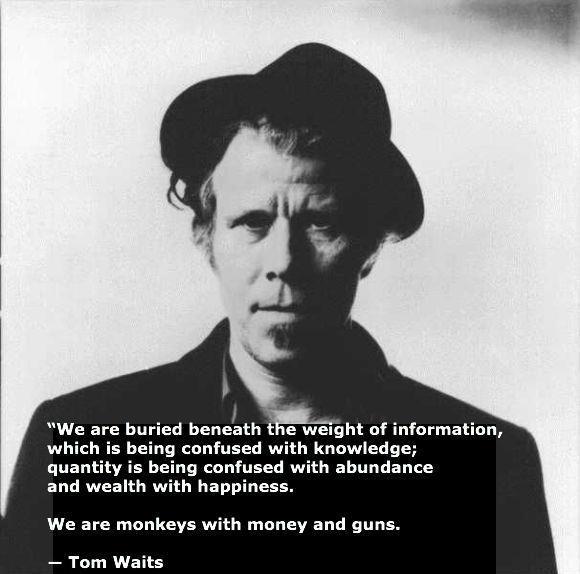
Tom Waits on habits
“It’s very hard to stop doing things you’re used to doing. You almost have to dismantle yourself and scatter it all around and then put a blindfold on and put it back together so that you avoid old habits.”
― Tom Waits
Wipe the slate clean every day.
You don’t need to worry about your reading lists. Mark them all as read. Don’t worry about all the social media posts you haven’t read. Don’t worry about all the blogs there are to search through, or all the news sites there are to keep up with. Each day, your slate is clean. Then you can decide how to fill that slate each day, and enjoy whatever you choose to experience.
Then let go, with a new slate each day.
Here’s what I’ve learned from not writing about my life because I was scared you wouldn’t like it: I’ve learned that you don’t care what I do in my life as long as I’m interesting. If I am doing something that’s scary, and I tell you, then you can identify with me when you do something scary. What this community is, really, is people who want to do something scary. Because life is very, very boring if we don’t scare ourselves.
After attending the Green Vale School in Old Brookville, N.Y., where her classmates included Gloria Vanderbilt, and graduating from St. Timothy’s School in Stevenson, Md., she turned down a scholarship to Radcliffe to marry Arthur Twining Hadley II, whom she later described as “handsome, but a cad.” Her mother handed her off with the only bit of intimate advice she ever imparted: “Don’t worry, Dear, sex will only last a year.”
Information is weird like that. It is its own ailment, its own deficiency, its own excess, its own cure. You flush out bad information with more (different) information. You fill a gap in information with more information. Programmers (and geneticists?) know: you could be just one character, one punctuation mark away from heaven.

We never see how the Doctor began his journey, we will probably never see how he ends it, we’ll probably never know why he embarked on it but we know all those companions who they were before they met the Doctor. The story is always about the person who changes the most rather than necessarily about the person who does the most – who effects those changes.
 Brownstudy's Blog