If you move a meeting forward, what does that really mean? | Oliver Burkeman | The Guardian

All of which is a reminder of how odd it is that we think of time using spatial metaphors at all – indeed, that it seems virtually impossible not to. Ask me about the coming month and I can’t help picturing a sequence of little boxes, like a calendar; ask me what I did yesterday and my eyes shoot upwards, as I consult a “space” somewhere behind my head. Your specific images may not match mine, but anthropologists suggest that the basic metaphor – “time is space” – is a cultural universal. Which is a pity, in a way, because I’m pretty sure it makes our experience of time more anguished than it needs to be.

Mark Forster wrote in one of his books about “spaciousness” being a quality of life he valued. When talking of how we move through the day, “spaciousness” evokes a different feeling than “cramped.”

As Burkeman says, time as space is a useful metaphor. Time is money, is another. An academic uses time the way a sculptor uses clay is another metaphor I’ve heard.

At this point in my development, metaphors are useful until they’re not. They’re fun to talk about and they can lead to insights sometimes, but it’s useful also to know when to let them go. And to know that they’re momentary thoughts.

“Time” does not really exist, the way trees and cars and physical bodies do. It’s a concept humans have made up because it’s useful to keep the trains running and we know when to celebrate birthdays, but time and its passing is a thought we create for ourselves. The way time can pass quickly or slowly to us — and differently for someone else in the same circumstance — is a clue that time is a thought we’re paying attention to (or not) in the moment.

As the mystics tell us, there is no past and no future. There is only now. What happens to the time-management industrial complex when there is only now? As someone for whom time management has been my shadow religion for nearly 30 years, this is something I’m pondering quite a bit.
Emergency funds

The Two Cents column on emergency funds has the good, standard advice offered by financial planners and investors. 

There’s a 1-3-6 guideline for deciding how much to save, with a link on the page to a different article offering a 3-6-9 guideline

Of course, this assumes you have enough money to squirrel away to being with. Most of my adult life was spent at interesting but lower-paying jobs and paying off credit card debt racked up during periods of unemployment. If I had enough cash to contribute to my 401K and cover my bills, anything extra went to paying off the credit card.

It is only fairly recently that I reached a certain comfort level with how much I have in the bank, but I will always feel I started too late and saved too little.

The YNAB blog has its own take on do you really need an emergency fund. YNAB, an online budgeting application, stands for “You Need a Budget”; I started using it about 1.5 years ago and wish I’d known about it years earlier. It changed my financial life (but that’s a story for another blog post).

I thought the YNAB article more applicable to my situation than the Two Cents piece. As the YNAB writer notes, and I’ve seen in my own finances, the more I’m tuned in to my priorities and budget categories, the less need I have of a line item for emergencies. 

If an emergency car repair or dermatology visit results in a surprise bill in the hundreds of dollars, I now have enough saved in those categories to cover the expense.  So emergencies are covered by my “true expenses” categories, where expenses are variable, hard to predict, but tend to be outsized.

Having enough money to cover an unexpected expense is a good feeling, one I’ve not had for most of my adult life, and I savor it.

“I need to figure that out…”

Over the years, I have set a few mental triggers for myself that let me know my thinking is revved up and running away with me. 

One of them is when I notice I’m talking to myself, either letting my in-my-head voice loose or carrying on my side of an argument that either has happened or has yet to happen.

Another is when I hear myself say “I need to figure that out…” This is usually a signal to me that I am in my head, my thinking is revved up, and I need to take a step back from the situation.

Saying “I need to figure it out” is like saying “I need to think about it more,” which is usually the last thing I need to do. When my mood is low, thinking about the problem just makes me feel worse. In fact, my feelings are an indicator that I should avoid actively thinking about the problem. 

I like the description of thinking as a power tool, like a drill. A drill is useful for specific tasks, but it’s not something to be used every day, as we would use a hammer or a screwdriver. Thinking is useful for planning a trip, troubleshooting a DSL connection — practical stuff. But thinking about concepts like my career, my life, my place in the world — the thinking there gets dicey and not to be trusted. 

Now, when I hear myself say that trigger phrase, it’s my cue to stand up, walk around, breathe deeply, get some blood flowing, change up what I’m focusing on — distract myself, in other words. Later on, an insight or next step may pop into my head when there is less thinking on my mind, and then I’m over the hump. 

Update: Dr. Amy Johnson, author of The Little Book of Big Change, posted a video circling around this question of “figuring things out.”  

Can a Male Artist Still Paint a Female Nude? | The Cut

While feminist art critics have for decades pointed out the shortcomings of the “male gaze,” the post-#MeToo reckoning with the art world’s systemic sexism, its finger-on-the-scale preference for male genius, has given that critique a newly powerful force. And the question of the moment has become: Is it still an artistically justifiable pursuit for a man to paint a naked woman?

I remember some 30-odd years ago reading John Berger’s Ways of Seeing and the two pages displaying female nudes, looking back at the viewer who is looking at them. Male nudes have never figured as much, except, as one of the quoted artists observes, Jesus naked on the cross.

The article, by Michael Slenske and Molly Langmuir, is in two parts. The first interviews male painters who continue to paint female nudes while the second enlists seven female artists to talk about men and women painting nude women and the effects of current — or in the case of Judy Chicago, past — events. 

But before you read, scroll down to the third part, titled “Duelling Gazes,” and study the gallery of female nudes. No artist names are attributed to the pictures. Instead, you are asked to guess who created each image: a man or a woman? Most all of the paintings are discussed in the article so you will eventually puzzle out who painted what. I wish I had done that before reading this article, to see how my own biases are calibrated.

I liked this quote from Marilyn Minter, whose paintings ran afoul of anti-pornography feminists in the last decades of the last century:

“I was a traitor to feminism, but my side won,” she says. “Now it’s the return of all that.” Her larger point? “There are no safe places: This is the world, it’s pretty awful, and it’s pretty great at the same time. But the minute you try to pin down sexuality, it’s going to spit in your face. It’s totally personal, it’s fluid. Trying to make rules is a waste of energy. Progressives can take each other apart — we do it all the time — when the bigger enemy is these neo-Nazis. That’s where the energy should be, not trying to police fucking paintings.”

The Guiding Greene Light of Harry Crews

“Graham Greene—you’ve probably heard me quote before, because god knows, it’s true—’The writer is doomed to live in an atmosphere of perpetual failure.’ There it is. There it is. Nah, you write things and write things—write a book for instance—and write and write and write and write and write, and you know, it’s not—every writer writes with the knowledge that nothing he writes is as good as it could be,” Crews told Dangerous Minds in 2010.


Sometimes the Best Way to Read is to Mark Up the Book | Literary Hub

In order to understand writing, I have to annotate it. I started with Hopkins. I bought a used edition of his selected poetry and prose, and started writing in the margins of the beige pages. This wasn’t defacing; this was an act of communion.

One of the joys for me of second hand books is reading the marginalia. It’s not always clever or profound, but sometimes I see the conversation, the interrogation, the connections made, between a reader and the text and it can be thrilling. I remember reading somewhere that Coleridge’s annotations and marginalia were so impressive that friends and patrons would pay him to read and annotate books that they would then keep as cherished keepsakes in their personal libraries.

I have a few books that so captured me I had to create my own index in the back of the book and underlined or scribbled in the margins beside a line or paragraph that unsettled me or caused me to see things in a different light. Guy Claxton’s Hare Brain, Tortoise Mind is one such book that leaps to mind. 

But Nick Ripatrazone is not so much in dialogue with the text he’s reading; instead, he’s making marks on the page to understand how the words make poetry. It’s a sign of my own ignorance and innocence that it never occurred to me to annotate a poem this way, but of course it makes perfect sense.

Fiction writers are advised to do the same thing: copy out by hand or keyboard a short story or even a novel that means something to you. (Harry Crews meticulously studied and typed out the whole of Graham Greene’s The End of the Affair.) By feeling every comma and period under your fingers, you’re engaging with the text not as a dreamer, but as a student, an apprentice.

The nearest thing I’ve done to what Ripatrazone describes is when I used to act. My script would be marked with blocking, underlined emphases, and — whenever I got a speech — breaking the long passage down into smaller passages with hash marks, finding a rhythm both musically and emotionally that the words could travel on. 

As pretty as a pristine edition of a book can be, there’s something about a book that’s been argued with, pored over, and written in that makes that book way more interesting.

Nancy for a new age

Orange Crate Art‘s ongoing coverage of the Nancy comic strip — from the acclaimed Fantagraphics book on how to read Nancy to the recent changeover of the daily strips to artist Olivia Jaimes — convinced me to start reading the strip. (See all his Nancy posts on his Pinboard page.)

I read this week’s strips and also like what he praises: its dryness, its cleverness, its hipness to what a kid and an audience would know about the current world. Tom the Dancing Bug’s sarcastic awareness of comics tropes seems an influence, also.

OCA also alerted me to the AVClub article on the controversy surrounding the changeover to Jaimes from the former daily artist Guy Gilchrist, who is still doing the Sunday strip. Fans tend to the conservative, so it’s understandable that those who knew what to expect from a daily Nancy strip now don’t know what they’re going to get. But that’s what I find exciting.


Soviet film posters of the ’50s and ’60s

The Guardian web site runs an online gallery of pictures or images on a theme. The movie posters here reflect the thaw under Khrushchev, though some of the movies themselves continued the East vs. West propaganda struggle and the rightness of the Soviet path. A few evoke Socialist Party poster images but you can see the designers straining for a bolder, more experimental style.

They don’t quite shake a literalism to the human figure and most lack a strong central image to anchor the composition. By contrast, Saul Bass’s striking poster designs for Vertigo and Anatomy of a Murder make bold statements that stop you dead and evoke a sense of the movie without directly illustrating an event. The Soviet posters feel more tentative, yet there is a quiet mood and craft to some of them that invite the eye to stop and linger. 

I love the red and black contrasts of 25 Baku Commissars, the scratchboard effect of Black Sunglasses, and the leaf-print/snowflake designs surrounding the couple in Young and Green.

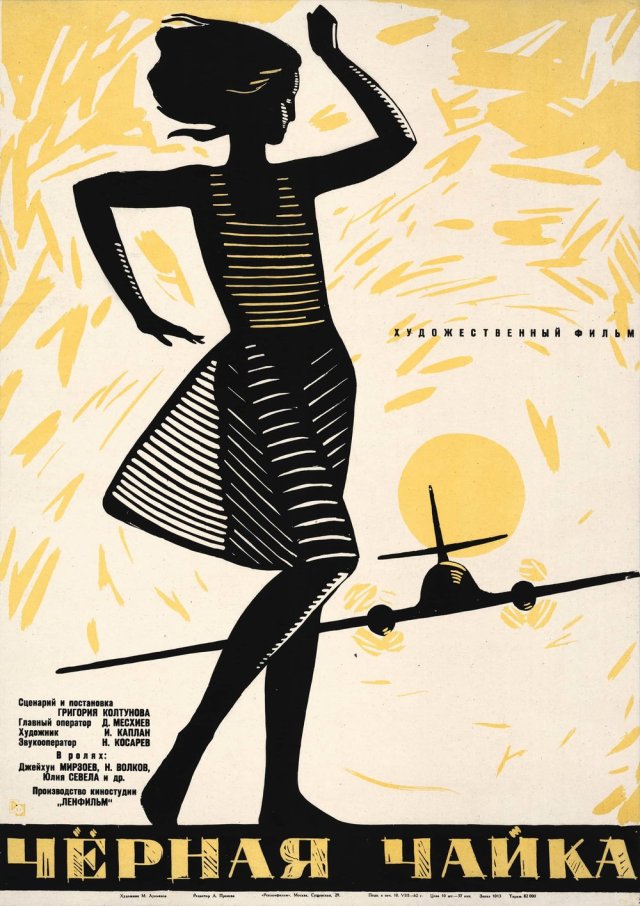
But if I had to pick one to take home with me and put on a wall, I think it would be Black Seagull: the image’s woodcut nature, the contrasting black-and-yellow palette, the stiff lines of the dress folds indicating movement, the primacy of the female image as the plane draws near — they all get my attention.

More on passwords

CriticalMAS read my post on creating Diceware passwords and in response posted a very cool Mad Libs ways to create secure yet memorable password. I like it. While I have memorized the long Diceware passwords I’ve created, I must admit it takes a while before they’re second-nature. 

And from the comments to CriticalMAS’s post, this gem from Gizmodo: The Guy Who Invented Those Annoying Password Rules Now Regrets Wasting Your Time.