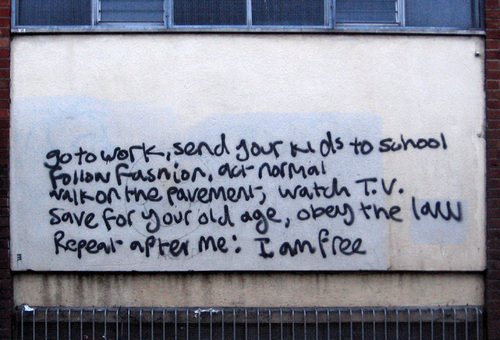



In his speech, Sterling seemed to affect Nietzschean disdain for regular people. If the goal was to provoke, it worked. To a crowd that typically prefers onward-and-upward news about technology, Sterling’s was a sadistically successful rhetorical strategy.
“Poor folk love their cellphones!” had the ring of one of those haughty but unforgettable expressions of condescension, like the Middle Eastern gem “The dogs bark, but the caravan moves on.” “Connectivity is poverty” was how a friend of mine summarized Sterling’s bold theme. Only the poor — defined broadly as those without better options — are obsessed with their connections. Anyone with a strong soul or a fat wallet turns his ringer off for good and cultivates private gardens that keep the hectic Web far away. The man of leisure, Sterling suggested, savors solitude, or intimacy with friends, presumably surrounded by books and film and paintings and wine and vinyl — original things that stay where they are and cannot be copied and corrupted and shot around the globe with a few clicks of a keyboard.
One major theme here is that complexity can be intimidating, but it can also be motivating. We need to find those conditions that make it motivating.
You know, in life, you have certain kinds of regrets. One kind of regret revolves around the opportunities you never had – what if I had had better schools, better teachers, better jobs, better finances. What if I had been treated fairly here, rewarded justly there, shown this in that place. Things I could never be, places I could never go. These are regrets over things I cannot control. But the other kind of regret – ah. The regret of a man who was not true to himself, who did not give his all, who held himself back or conformed for the sake of advancement, of the man who stopped seeking because he was told what to believe: these are the regrets I could not bear to feel.
- <!–
–>
Once you make a decision, commit and go for it. Don’t continually second guess yourself. If you have to change course, you have to change course. If you never commit, all you will ever do is change course.
Vaynerchuk tells anecdotes, but his main activities veer more into the uncool profession of teaching. In the above-linked interview he admits to being a “class clown,” and I have found in my twenty years of teaching that that one characteristic is a better predictor of who ends up a teacher in life than any other.
The class clown seems to be the opposite of the teacher– loud, disruptive, dismissive, and seeming to want to be anywhere else but class– but in reality, I’ve found, the clown feels completely at home in class, envies the teacher’s ability to hog all the attention, and secretly wants to be the one in front of the whiteboard with the dry erase marker, telling everyone what matters.
My future is assured
Vaynerchuk tells anecdotes, but his main activities veer more into the uncool profession of teaching. In the above-linked interview he admits to being a “class clown,” and I have found in my twenty years of teaching that that one characteristic is a better predictor of who ends up a teacher in life than any other.
The class clown seems to be the opposite of the teacher– loud, disruptive, dismissive, and seeming to want to be anywhere else but class– but in reality, I’ve found, the clown feels completely at home in class, envies the teacher’s ability to hog all the attention, and secretly wants to be the one in front of the whiteboard with the dry erase marker, telling everyone what matters.
 Brownstudy's Blog